
Mendocino County News Sources
Start with the official layer. The MCSO publications index gathers agency material in one place. The MCSO Media Logs page holds dated daily PDFs describing dispatch and law-enforcement activity. A log is not a booking list. Some calls close with no arrest at all. Press material may include an agency photo when release is lawful and serves a purpose, but the agency promises no steady stream of arrest images.
MCSO Citizen Connect layers on map, list, trend, and alert views of incident patterns. The interface covers up to thirty days at a time. It opens near a shorter recent window and warns that its data lags a bit. It is not a jail roster or a photo source. Use it for place and event context. When the question is whether someone actually entered Mendocino County Jail, go to the booking system.
Social accounts post selected releases and public-safety updates too. California law limits how agencies may publish booking photographs of nonviolent arrests on social media, with defined exceptions and removal duties. That rule does not turn the Sheriff's own booking database into a gallery. The MCSO Booking Log, in fact, withholds all booking photos online.
Note: A missing MCSO social post never proves that no Mendocino County booking happened.
Mendocino County News Outlet Map
Mendocino County crime news reads like a running narrative, not a newspaper mugshot gallery. Stories appear as incidents unfold or as agencies issue releases. Every outlet weighs one corner of the county more than others. Several archive searches also blend local items with outside material. Treat the "Photos?" column as a description of each outlet's practice, not a claim that every person image came from a booking.
| Outlet | Coverage | Photos? | Where |
|---|---|---|---|
| MCSO | Official county releases and daily event logs | Selected agency images, not a gallery | Publications and Media Logs above |
| The Mendocino Voice | Countywide police and courts, including Ukiah, Willits, Fort Bragg, and unincorporated areas | Story-specific scene, file, logo, or credited images | Police & Courts section |
| Ukiah Daily Journal | Ukiah and countywide UPD or MCSO stories as releases arrive | May use a source image or generic placeholder | Arrest search archive |
| Anderson Valley Advertiser | Frequent county roundup with crime among broader local items | Article-specific images | Mendocino County Today |
| Willits News | Willits context mixed with syndicated and cross-posted results | No stable photo practice established | Arrest search archive |
| Fort Bragg Advocate-News | Coast stories mixed with many nonlocal results | Varies by article | Arrest search archive |
| Mendocino Beacon | Possible coast-story context, not a booking feed | Varies by article | Arrest search archive |
The Mendocino Voice stands out as the strongest countywide police-and-courts navigator. The Ukiah Daily Journal tends to follow named MCSO and Ukiah Police releases. The Anderson Valley Advertiser runs broad back-to-back roundups. Willits News, the Advocate-News, and the Mendocino Beacon add local color, though their search pages mix in too much outside material to promise complete or fixed-cadence crime coverage.
The Ukiah Daily Journal arrest archive shows what a news search looks like, not an official feed. Open the live source to see its current results.
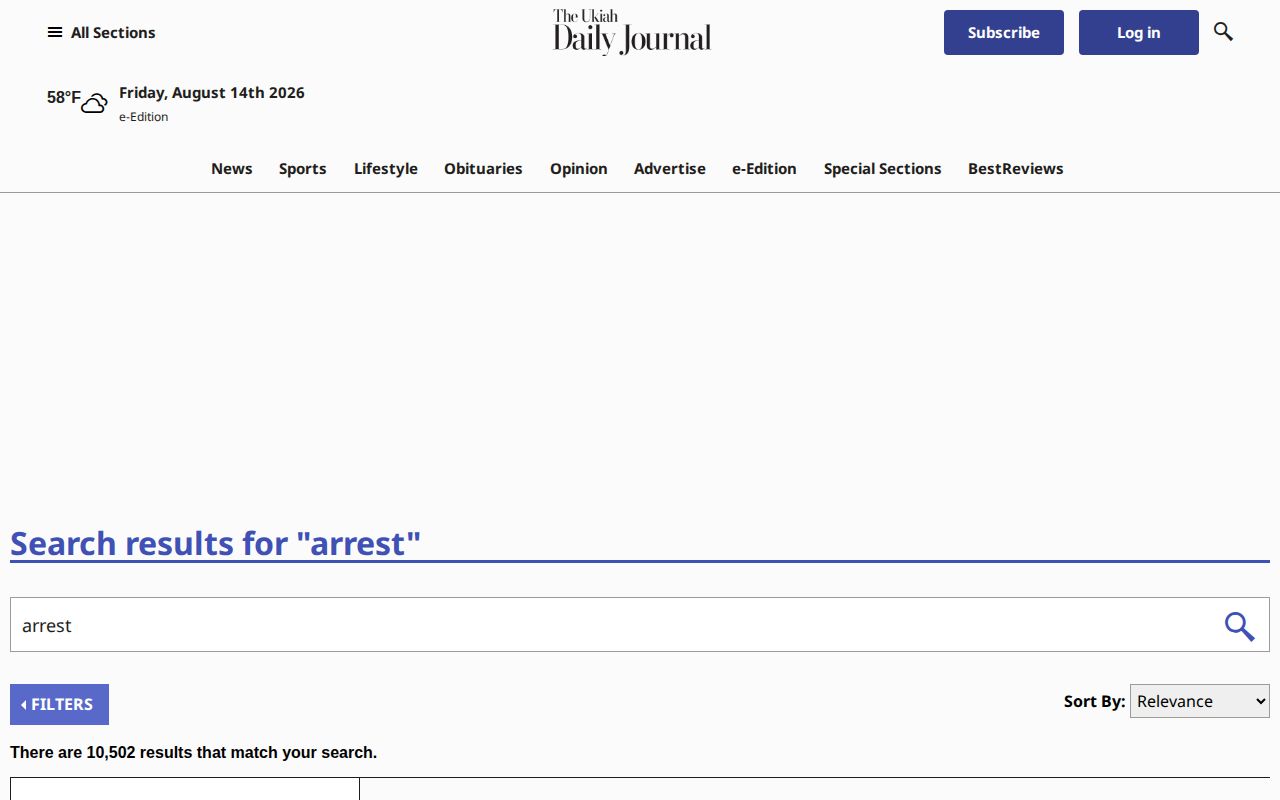
That archive format explains why source and date checks matter so much. Results mix fresh releases with older stories, and the images chosen may look nothing like the county's own record.
Mendocino County Media Logs
MCSO keeps its dated Media Log PDFs separate from New World Inmate Inquiry, a distinctive local arrangement. A media log helps you tie a place, an event type, and an agency to a later news story. The booking log works the other way. It starts at county jail intake. The two should never be confused for each other.
Compare event date, place, and responsible agency first. Then ask whether the event truly led to a booking. A call might end in a citation, a field release, a transfer, a hospital admission, a juvenile procedure, or nothing at all. The reverse also happens. A booking can lack any clean match to a public event line. PDF filename dates and upload timing can diverge too, especially when an older log gets backfilled.
The county booking interface works as a same-day feed on its default date. It becomes a multi-day view once you pick a range. It reaches back only through the published recent window, and no verified official 24-hour or 48-hour product exists. The Mendocino County booking and roster treatment covers how those filters shape the custody slice you see.
Note: A media-log entry gives event context, but it is not proof of a jail admission or of a crime.
How Photos Reach Mendocino News
Where did the picture come from? A crime-story image might be an agency press photo, a wanted notice, a scene shot, a courtroom sketch, a reader submission, an old file image, or a booking photograph pulled through a records request. Lumping every person photo under the word mugshot blurs those lines. It can also misstate what the outlet actually received.
- Agency press image
- A photograph selected and distributed for a specific release.
- Wanted image
- An image published to seek public help locating a named subject.
- Booking photograph
- An identification image made during jail intake, which MCSO does not show in its online Booking Log.
- Scene or file photograph
- A location, vehicle, building, prior event, or other contextual image.
California's Public Records Act opens the door to many arrest facts. Booking photos are not automatically part of the deal. The Sheriff's Office can hold one back for privacy, safety, investigative, or sealing reasons. A newsroom may also pass on a photo it thinks adds nothing. So when a story runs without a mugshot, that gap usually reflects a legal limit or an editorial call rather than concealment.
Social media follows different rules. Penal Code section 13665 bars agencies from posting booking photographs of people arrested for nonviolent offenses, unless a listed exception applies. The statute also spells out how covered posts come down. An agency's own website sits outside it. MCSO's decision to run a booking log without photos stands on its own as a local publishing choice.
Mendocino County Third-Party Pages
Two commercial sites carry Mendocino County sections worth knowing about. Recently Booked's Mendocino County section lists arrest cards and face images newest-first, and the site says it refreshes often. It does not say which agency supplied each entry. Mugshots.com's Mendocino County section offers a county search plus city filters, but the publisher itself disclaims accuracy and timeliness, and no dependable update schedule exists. Treat both as secondary leads, not official rosters.
| Third-party page | What it may add | Required caution |
|---|---|---|
| Recently Booked | County and city grouping with arrest cards | Unofficial, potentially stale, incomplete, duplicated, or inconsistent with court records |
| Mugshots.com | County search and alphabetic name navigation | Unofficial, no verified cadence, and not a source of final case outcomes |
Busted Newspaper, Arrests.org, and Mugshots.zone have no confirmed Mendocino-local section, and JailBase coverage is unverified. Don't substitute guessed county links for the missing pages. Also beware lookalikes: a private domain with "Mendocino County jail" in its name is not the Sheriff's Office.
These galleries have real staying power. A booking can linger in a commercial index long after MCSO's brief online window closes, and an old page may not reflect a dismissal, sealing order, or amended charge. Check the official booking first, then the court file. No private gallery should outrank the agency and court records that created the trail.
Note: A third-party page's publication date may mark its own update, not the date a court resolved anything.
Trace Mendocino News to Records
A news clip is a starting point. It is not the whole file. So grab the basics first. Note which outlet ran the story and when it ran. Jot down the named agency and where the incident supposedly happened. Write down the exact charge language too. Then work through the official Mendocino County sources one at a time. A headline can't tell you who is still in custody or how a case ended. Records can.
- Open the original story and identify whether it cites MCSO, Ukiah Police, Fort Bragg Police, Willits Police, CHP, or another agency. Note whether the image attribution says agency, file, scene, or booking photo.
- Check the MCSO Media Log for matching event context. Do not assume every matching call produced an arrest.
- Search the MCSO Booking Log by legal name and a narrow date. Clear the in-custody filter if the person may have been released, and verify birth date or descriptors rather than relying on name alone.
- Open the booking detail and record the booking number, arresting agency, alleged charge rows, and any Superior Court docket number. A blank disposition field is not a case result.
- Use the docket number or authorized court access to find the filed case. Check later events and obtain the disposition from the court clerk when needed.
Custody status shifts at every stage. So match your search to where the person likely sits. Someone just processed shows up in the default daily view. A person still held can be isolated with the in-custody filter. Date-range results may still surface someone released days ago. A commitment to state prison, though, lives in CDCR records rather than the county news archive.
Mendocino County Court Outcomes
Many MCSO charge rows expose a Superior Court docket number. That creates an unusually direct bridge from a short-lived booking snapshot to the longer court record. Follow each docket number when a booking contains several charge rows. Do not treat the booking heading as the final charging document or merge separate dockets into one result.
The court phase can include arraignment, release or bail orders, motions, plea, trial, dismissal, diversion, sentencing, and appeal. A calendar only shows that a hearing was scheduled. It does not prove the hearing occurred or state its result. General public remote access to criminal files may also be limited, so nonconfidential material may require a courthouse kiosk or a request to the clerk.
Use precise source labels when comparing records. “Reported by a local outlet,” “booking allegation shown by MCSO,” and “court disposition” describe different stages. If a story needs correction, the official disposition, dismissal, or sealing document is stronger evidence than the fact that a name disappeared from the recent booking window.
Read Mendocino County News Carefully
Local outlets supply what a roster row never could. They reconstruct the reported sequence, quote officials, pin down locations, and follow up as a case develops. None of it amounts to a full county arrest log, though. Posting schedules vary. Archive searches can also jumble current stories with old, syndicated, or unrelated hits.
The Anderson Valley Advertiser runs a broad county roundup where police items sit beside civic and community news. Read its Mendocino County Today source as a roundup, not a roster.

That mixed format points to one workflow. Take the story for context. Then confirm the booking and court stages with the offices that keep those records. Before repeating any claim, check the caption, the attribution, the publication date, the agency source, and whatever the court file later shows. An image can amplify a headline without adding a thing to the underlying facts.